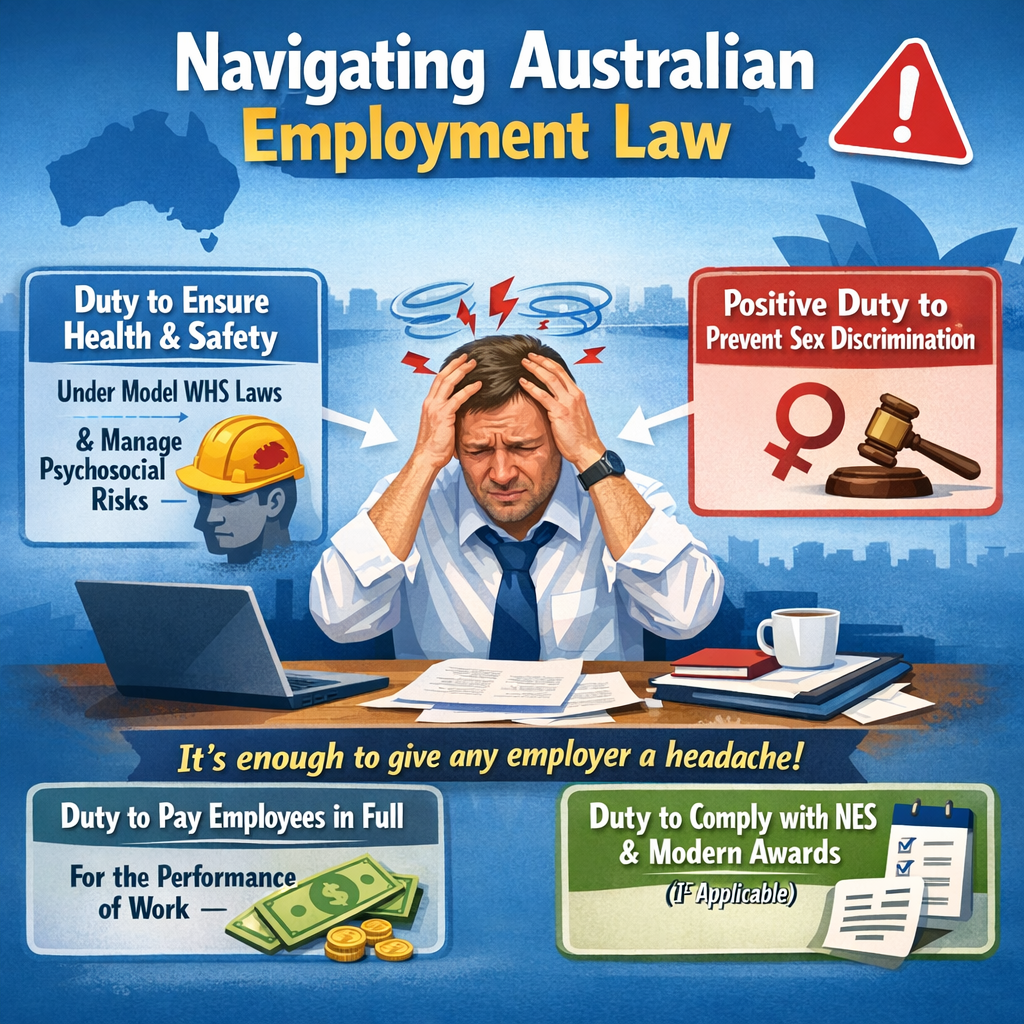
Navigating Australian Employment & Industrial Relations Laws: Key Duties Every Employer Must Meet
Employment law compliance in Australia is complex, and the risks are increasing. Whether you’re a small business, a growing startup, a medium business or a large national employer, compliance isn’t optional: the legal, financial, and reputational risks of getting it wrong are significant.
Your Key Legal Duties
Australian employers are primarily governed by the Fair Work Act 2009 (Cth), and they are legally required to:
-
- Provide a workplace that is safe, and manage psychosocial hazards
-
- Take reasonable and proportionate measures to prevent sex discrimination, bullying, and harassment (including sexual harassment)
-
- Ensure employees are paid correctly, in full, and on time
-
- Comply with the National Employment Standards (NES)
-
- Comply with the modern awards(s) that apply to their industry and their employees (if applicable)
-
- Maintain records and meet consultation requirements.
Failing to meet these duties can expose an Australian employer to:
-
- Unfair dismissal claims
-
- General protections claims
-
- WHS prosecutions
-
- Workers compensation claims
-
- Reputational damage
Duty to provide a Safe Workplace (WHS)
Under the model Work Health and Safety (WHS) Laws, an employer (PCBU) must ensure, so far as reasonably practicable:
-
- The health and safety of workers
-
- A work environment without physical or psychological risks
-
- Safe systems of work
-
- Adequate supervision and training
-
- Proper risk management processes
This includes both physical hazards (equipment, environment) and psychosocial hazards (bullying, work pressure, conflict, aggression, fatigue).
Proactively manage Psychosocial Risks & Hazards
Employers must proactively manage psychosocial risks and hazards in the workplace, such as:
-
- Bullying, harassment and aggression
-
- Exposure to traumatic events
-
- Workload pressure
-
- Low role clarity
-
- Poor organisational change management
-
- Remote or isolated work
-
- Conflict between employees.
Non-compliance may result in complaints, investigations, improvement notices, fines, and in severe cases, prosecutions.
Ensure employees are paid correctly
Employers must ensure their employees are paid correctly, and as part of this, they must know what modern awards (if any) apply to the work being performed by their employees. Award coverage can be difficult to determine, but taking the time to determine award coverage is essential, as the cost can be high if an employer gets it wrong. Employers must:
-
- Pay at least the minimum wage
-
- Meet all award or enterprise-agreement based entitlements
-
- Pay overtime, penalty rates and allowances, where required
-
- Provide the correct final pay, including notice and accrued entitlements.
Comply with the National Employment Standards (NES)
The National Employment Standards (NES) are 11 minimum entitlements that apply to all national system employees. They cover:
-
- Maximum weekly hours
-
- Requests for flexible working arrangements
-
- Annual leave (4 weeks for full-time employees or 5 weeks for certain shiftworkers))
-
- Personal/carer’s leave (10 days per year for full-time employees)
-
- Parental leave
-
- Public holidays
-
- Notice of termination and redundancy pay
Employers cannot contract out of the NES.
The NES are currently being reviewed. Contact HintonFlynn Legal to keep you up-to-date on developments.
Comply with Modern Awards
Modern awards set legally enforceable minimum pay rates and employment conditions. Determining award coverage can be difficult. Use of an employment contract does not mean a modern award does not apply.
Employers must understand what award(s) cover their employees and the work they perform. Awards determine such things as:
-
- Classification levels and pay rates
-
- Overtime and penalty rates
-
- Allowances
-
- Meal breaks and rest breaks
-
- Rostering arrangements
If an employer fails to understand which award(s) apply to their employees, this ignorance could lead to a dispute or an underpayment claim.
Maintain Accurate Records
Employers must keep accurate and up-to-date records of:
-
- Hours worked
-
- Wages, loadings, allowances
-
- Superannuation contributions
-
- Leave accruals and the taking of leave
-
- Payslips
Poor record-keeping has been at the heart of recent underpayment cases, with courts ruling that inadequate records cannot be relied on, particularly when annual salaries are paid to award-covered employees.
Meet Consultation Requirements
Modern awards and enterprise agreemens typically require employers to consult with employees when:
-
- Introducing major workplace change
-
- Adjusting rosters or working hours
-
- Implementing restructures that may affect job security
Employers must understand , and meet, their consultation obligations. Preparation is key; do not leave consultation to the last minute.
HintonFlynn Legal Can Help
Navigating compliance can be complex, stressful, and time-sensitive. Proactive compliance not only reduces risk but also strengthens workplace culture, trust and long-term operational stability. HintonFlynn Legal is uniquely positioned to help you navigate your key duties. Reach out and call Pamela Flynn on +61 420 362 579 today.