
What are psychosocial hazards?
Pscyhosocial hazards can include:
-
- high or unrealistic workloads;
-
- role ambiguity;
-
- bullying;
-
- harassment;
-
- interpersonal conflict;
-
- poor supervisor support;
-
- exposure to traumatic events; and
-
- isolation in remote or hybrid work environments.
What does an employer need to do?
All employers in NSW must comply with their obligations under the Work Health and Safety Regulation 2025 (NSW), which commenced on 22 August 2025.
Under the Work Health and Safety Regulation 2025 (NSW), an employer must, in managing risks to health and safety, identify reasonably foreseeable hazards that could give rise to risks to health and safety.
An employer must, in managing risks to health and safety:
-
- eliminate risks to health and safety so far as is reasonably practicable, and
-
- if it is not reasonably practicable to eliminate risks to health and safety, minimise those risks so far as is reasonably practicable.
What should an employer do if it is not reasonably practicable to eliminate psychosocial hazards?
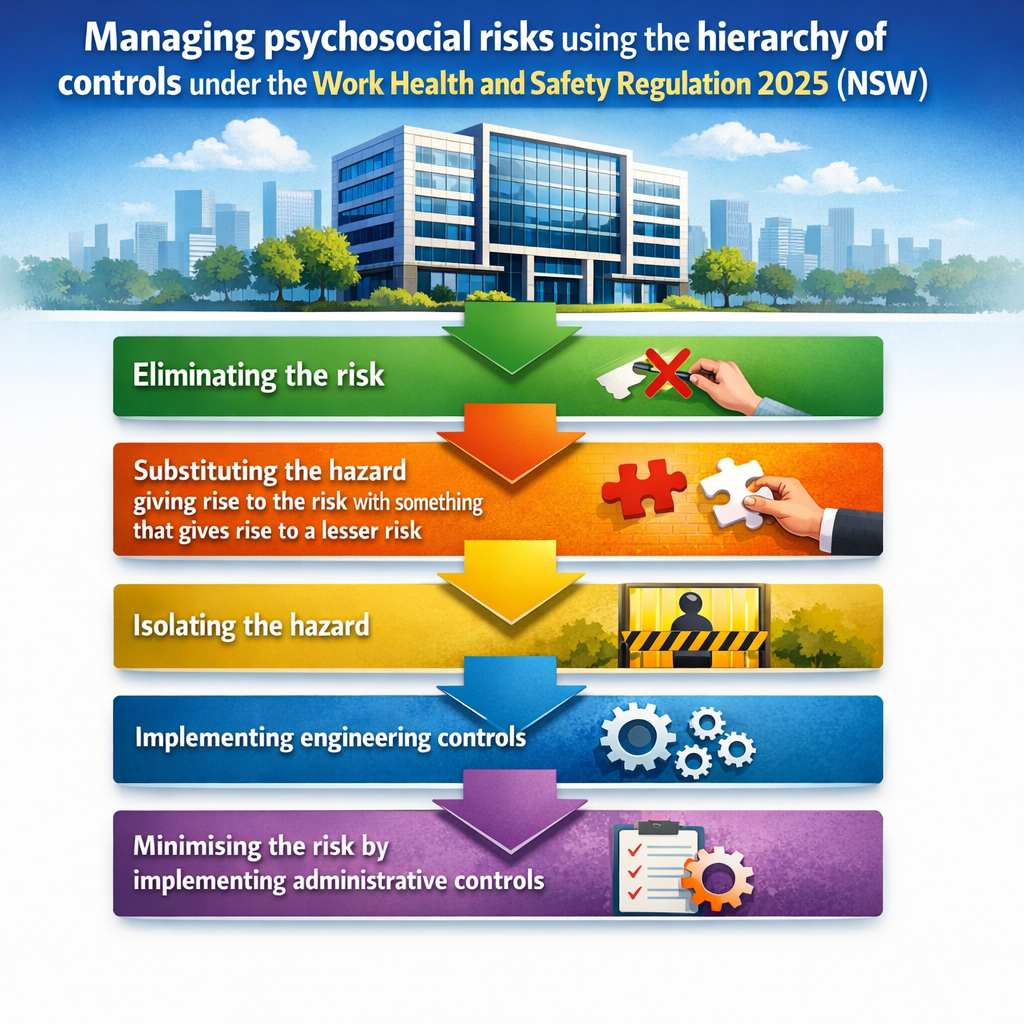
An employer must implement risk control measures in accordance with the hierarchy of control measures set out in regulation 36 of the Work Health and Safety Regulation 2025 (NSW). In general terms, and in the context of psychosocial hazards, an employer must:
Step 1: Do one or more of the following:
-
- substitute (wholly or partly) the hazard giving rise to the risk with something that gives rise to a lesser risk
-
- isolating the hazard from any person exposed to it
-
- implementing engineering controls.
Step 2: If a risk remains, the employer must minimise the remaining risk, so far as is reasonably practicable, by implementing administrative controls.
Proactive management of psychosocial hazards not only helps an employer meet its legal obligations, but it helps improve workplace culture. If you need help assessing risks or responding to emerging issues, reach out to HintonFlynn Legal today.
Please note: Whilst HintonFlynn Legal makes every effort to ensure the information on this page and throughout this website is accurate and up-to-date, it is provided for general guidance only. It is not intended to be legal advice. You should obtain specific legal advice from HintonFlynn Legal regarding your individual situation and circumstances.